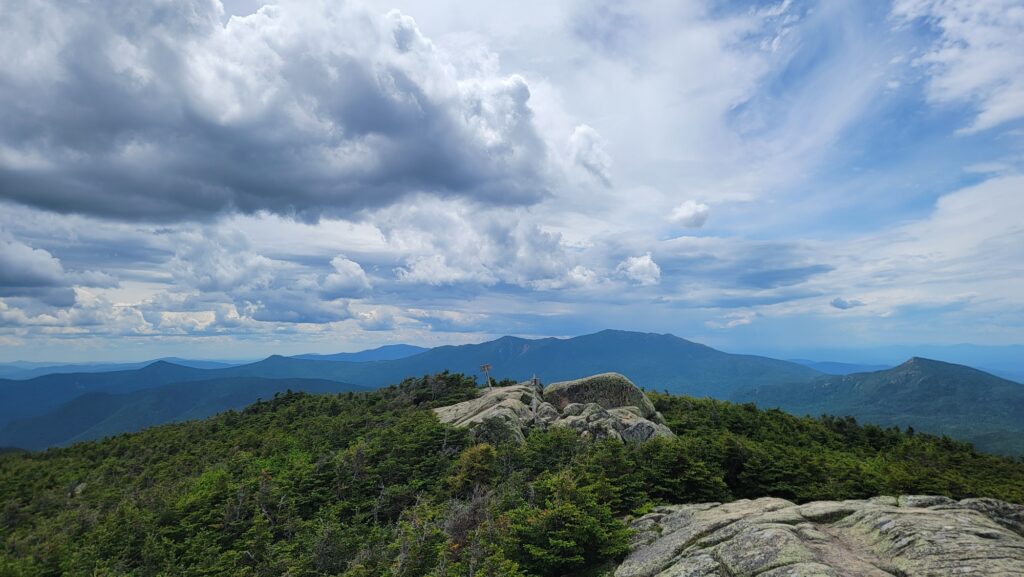
Somewhere between Zealand Falls and Galehead Hut, I realized that looking too far ahead was not helping me move faster. It was making me less safe.
The trail demanded something more immediate. One wet rock. One root. One ledge. One careful shift of weight at a time.
That is also how leadership works in periods of change. The destination matters. But when the terrain gets steep, the next step becomes the strategy.
I spent three days hiking a rugged stretch of the Appalachian Trail through New Hampshire’s White Mountains, including the Twinway near South Twin Mountain, elevation 4,902 feet. This is where the trail stops feeling like a walking path. It becomes steep climbs, rock steps, roots, wet slabs, exposed ridgelines, and slow technical descents.
It’s the kind of terrain where one mile can take an hour.
I have a love/hate relationship with these mountains. Hiking in the Whites reminds me of how I feel when people ask whether I like writing. Do I like writing? I like having written. Do I like hiking? I like having hiked.
Moving that slowly, with no cell service, gave me plenty of time to think about what difficult terrain teaches leaders about change. The lessons include:
- The destination matters, but the next step gets you there.
- Looking too far ahead can make you less effective.
- Presence is a leadership discipline.
- Rest is part of the strategy.
The Destination Matters, But The Next Step Gets You There
I knew where I was going. Galehead Hut was the destination. And I had to arrive before 6 p.m., when dinner was served.
That mattered. Without that larger direction, the day would have had no structure. The destination shaped the route, the timing, the energy, and the reason to keep moving when the trail got hard.
But knowing the destination did not tell me where to place my foot on the next wet rock.
That is the first lesson for leaders navigating change. Direction matters. People need to know where your organization (or team) is headed and why the effort is worth it. Clarity of destination creates meaning. It gives people a sense of purpose, priority, and focus.
But direction is not the same as certainty.
In complex change, people often want the whole map. They want the sequence, the timeline, the risks, the dependencies, and the adoption curve all figured out in advance. That instinct is understandable. People feel safer when the future looks planned.
Hard terrain does not reveal itself all at once. Neither does change.
The next useful step often becomes visible only when you are close enough to see it. A leader’s job is not to pretend the full path is clear. It is to hold the destination steady while helping people make the next wise move from where they actually are.
That might mean clarifying one decision. Removing one obstacle. Naming one tradeoff. Resetting one priority. Giving a team permission to stop doing something so they can focus on what matters now.
And sometimes, it means taking one imperfect step, learning from the ground beneath you, and adjusting before the next one.
When the terrain gets steep, leaders have to shrink the distance between vision and action. Keep the destination visible. Then help people find their footing right here.
Looking too far ahead can make you less effective.
On that section of trail, looking ahead felt responsible.
I wanted to see what was coming. I wanted to scan the climb, anticipate the descent, and know how bad the next stretch was going to be.
But the more I looked ahead, the less effective I became.
If I looked two steps ahead, I missed the step I was taking. If I focused on the next ledge, I stopped seeing the wet rock under my boot. If I tried to plan the next ten feet, I increased the odds that I would slip in the next ten inches.
The trail did not reward future-casting. It rewarded attention.
That is hard for leaders because leadership often rewards the opposite. Leaders are expected to think ahead, plan ahead, anticipate risk, and prepare people for what’s coming next. All of that matters. But in periods of change, too much future-focus can become a liability.
When leaders stare too far down the trail, they miss the signals right underfoot.
A team is confused. A priority is competing with another priority. A meeting ends with polite agreement but no real commitment. A key employee is saying yes while quietly disengaging. A decision everyone thought was clear is still being interpreted five different ways.
These are not small things. They are rocks under the boot.
The mistake is thinking that strategic leadership always means looking farther out. Sometimes it means looking closer in. It means noticing and getting curious:
- What is the next conversation that needs to happen?
- What obstacle is slowing people down right now?
- Where are people pretending to understand something they do not understand?
The leader who looks too far ahead can sound visionary while becoming less useful. The leader who stays close to the present can help people regain traction.
On hard terrain, two steps ahead is too far if it keeps you from seeing where your foot is landing now. The same is true in change. The future matters. But the next step deserves your full attention.

Presence is a leadership discipline.
On difficult terrain, presence is not a soft skill. It is a safety skill.
On the Twinway, every step required attention. Foot placement. Balance. Breathing. Weather. Fatigue. The condition of the rock. The angle of the descent. The way my legs felt after hours of going up and down.
There was no autopilot available.
That is what made the trail so demanding. It wasn’t just physically hard; it was mentally consuming. I couldn’t drift off, check out, or assume the next step would be like the last one. The terrain kept changing, and I had to keep noticing.
Leadership in change works the same way.
Presence means staying close enough to reality to see what is actually happening. Not what the plan or last updated deck said would happen. What’s happening now.
That requires discipline because the pressure of change pulls leaders away from presence. It pushes them toward speed and achievement. Leaders want to sound confident and show progress. They want to prove they have the situation under control.
But presence asks for something different.
It asks leaders to pause long enough to notice the current terrain:
- Where is the team losing energy?
• What decision is creating drag?
• What are people not saying out loud?
• Where has the plan stopped matching reality?
• What does this moment require now?
That kind of presence is not hesitation. It is not indecision. It is how leaders keep judgment connected to reality.
When leaders lose presence, they start leading from memory, habit, or assumption. They stick to the plan, even when the ground has changed. They push for alignment without noticing confusion. They ask for speed when the team needs footing.
On the trail, the cost of losing presence was immediate. A missed rock. A twisted ankle. A fall.
In organizations, the cost can be harder to see at first, but it’s just as real. People disengage. Trust thins. Priorities blur. Small problems become structural ones because no one stopped long enough to see them clearly.
Presence is the discipline of staying awake to the terrain while still moving through it.
For leaders, that may be the most important skill in a transition. Presence is not having every answer. It’s being aware enough to see the next honest move.
Rest Is Part Of The Strategy
Pace is dictated by the terrain, not ambition.
On the trail, rushing did not make me faster. It made me sloppier. Some stretches allowed momentum. Others required me to slow down, plant my foot carefully, breathe, and recalibrate. The mountain didn’t care how quickly I wanted to move. It only responded to whether I was moving well.
Change works the same way.
Leaders often push for speed because they want momentum. That instinct makes sense. In uncertainty, movement feels like control. But speed without footing creates slips. The goal is not to move as fast as possible, but to move as fast as the conditions can honestly support.
That means rest is not separate from the work. It’s part of the work.
On the Twinway, staying present step after step was exhausting. It required constant attention. Foot placement. Balance. Fatigue. Risk. The terrain never stopped asking for focus.
And when that focus started to fade, the margin for error got smaller.
The same thing happens in organizations. Change consumes attention. New priorities, new roles, new tools, new decisions, new expectations. Each one may be manageable on its own. Together, they create cognitive load.
Leaders often underestimate that load. They assume resistance means people are unwilling. Sometimes people are simply overloaded. They’re trying to keep moving while also processing new information, managing uncertainty, and doing their regular jobs.
When capacity drops, judgment suffers. People rush, miss signals, and avoid hard conversations. They make decisions from depletion rather than from clarity.
That is why recovery is strategic.
Teams need moments to pause, absorb, recalibrate, and regain footing. Leaders do too. Without recovery, presence deteriorates. And when presence deteriorates, so does judgment.
In hard terrain, rest is not the opposite of progress. It is what makes progress sustainable.
The same is true in change. A smart pause can protect the next step. It can help a team see what’s shifted, what’s become too heavy, and what needs to be adjusted before moving again.
Leaders do not serve people by pretending the pace is easy. Employees aren’t naïve. Leaders serve them better by matching the pace to the terrain, building in recovery, and helping everyone keep enough focus for the road ahead.
The Next Step Is Not Small
By the time I reached Galehead Hut, I was tired in a way that felt different from ordinary fatigue. My legs were tired, yes. But so was my attention.
The trail had demanded all of it.
I could not think my way across the Twinway from a distance. I had to move across it one step at a time. Look. Choose. Step. Adjust. Pause. Repeat.
The next step can sound small. On difficult terrain, it is everything.
A careless step can injure you. A grounded step gives you balance. Enough grounded steps eventually get you across a ridge that looked impossible from the trailhead.
The same is true in leadership. Big change doesn’t happen because leaders see every step in advance. It happens because they help people take the next right step with attention, honesty, and care.
And because that kind of attention is demanding, wise leaders also know when to pause.
The destination matters. But when the terrain gets steep, the next step is the strategy. And the pause is what makes the next step possible.